
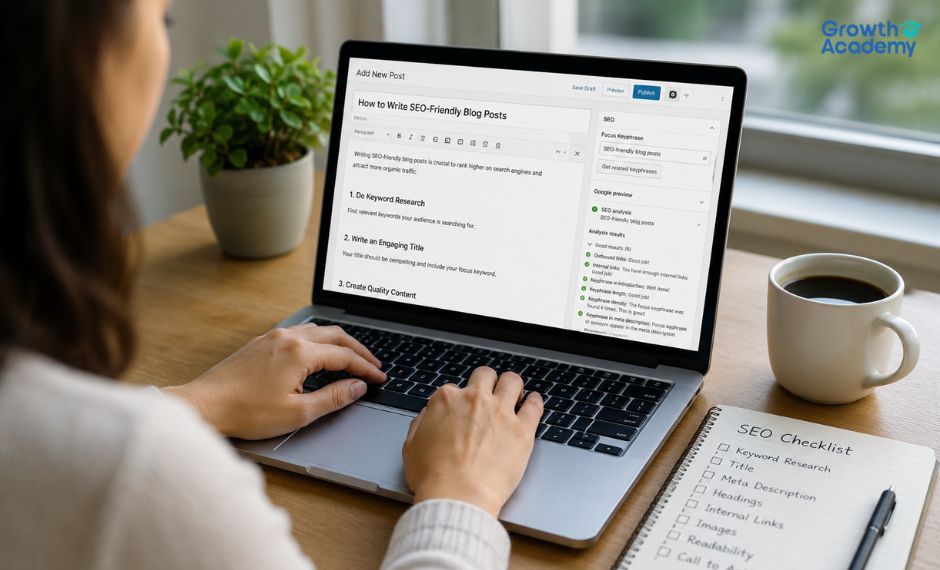
SEO-friendly blogs are a direct & effective pathway to drive organic traffic and improve SERP rankings. As AI interventions are gaining traction and Google is constantly evolving its guidelines. AI being an important stakeholder in deciding the website rankings, blogs must also be optimized for getting cited in AI overviews. So, you are not just writing for Google anymore; your writing is also scrutinized by highly sophisticated AI engines like Gemini, Chat GPT, and most importantly, real human readers will click back when the content doesn’t hook them. Let’s look at some techniques to implement for creating a good blog post that ranks well among the others, no fluff just legitimate stuff.
Before typing a single word, think about why anyone would look for this information. Google does not rank your content, but rather its relevance. The keyword "digital marketing training in Kozhikode" might represent someone who wishes to enroll in the program in the specific location, someone comparing their options, or someone wishing to learn more about digital marketing itself. These are three very different motives, and your blog post must target one of them directly. Tools such as Google Search Console, Ahrefs, and even Google's "People Also Ask" will give you insight into your target audience's needs. Now all you need to do is meet those needs through your blog post. Insertion of FAQ sessions, relevant headings and sub headings which matches the search intent, simple & understandable writing, etc helps a lot when coming to the rankings.
Both Google's crawlers and LLMs appreciate structured content. Structure your article using a hierarchy:
In addition to headings, divide your text into paragraphs, with three to four sentences per paragraph recommended. Use your primary keyword naturally at least once in the opening sentences, in one of your subheadings, and again in the concluding paragraph. Avoid the stuffing of keywords, as its adversely affects the content. And when speaking about the concluding paragraph, be sure to create a meta description. This will not improve your search ranking but will influence your click-through rate.
This is where many bloggers make their biggest mistake. Their focus on meeting SEO requirements renders their posts too mechanical in nature. The readers will not wholly consume such content. Quality SEO-written content appears to have been written by a person who really knows what he's talking about. This incorporates:
Technical skills don’t work, if the writing can’t connect with the people.
On-page SEO is what you have control over, and it remains very important. Here’s the checklist: -
The current generation of artificial intelligence engines such as ChatGPT, Gemini, and Perplexity can now provide direct answers to users questions, sourcing information from blogs and website articles. Your website article will have a chance of being cited or referenced within an AI answer if you produce content that provides valuable insights. This phenomenon is commonly referred to as Generative Engine Optimization (GEO).
1. Answer questions directly - If your blog is titled "How to write SEO blogs," try to answer that question within the first few paragraphs, don't save it for the end.
2. Use FAQ sections - LLMs love pulling from clearly formatted Q&A content. A short FAQ at the end of your blog can dramatically improve your chances of being cited in AI responses.
3. Be factual and cite your reasoning - AI systems are trained to prefer accurate, trustworthy content. Vague advice gets ignored. Specific, grounded information gets picked up.
4. Cover the topic completely - Thin content doesn't serve LLMs or readers. A blog that comprehensively covers a topic is far more likely to be referenced than one that only skims through the surface.
5. Use natural language questions as subheadings - Things like "What makes a blog SEO-friendly?" mirror how people actually talk to AI assistants, making your content more likely to match those queries.
How long should your blog be? As long as to address the issue thoroughly and no longer. For information-related blogs, 800-1,500 words usually suffice. The length of a blog does not make it valuable only the internal content will bring benefits. The freshness factor should be considered as well. Google tends to promote fresh content. Updating an existing blog with new facts, statistics, and links might help significantly improve its ratings while saving you time. What about consistency? It is far better to publish one high-quality blog per month rather than four mediocre blogs. Schedule them ahead and stick to the schedule.
Optimizing blogs for SEO is not about beating or gaming the algorithm, it's about creating valuable, structurally sound, and easily discoverable content both for human users and the machine. Do that, and you will naturally see your rankings increase. To learn more about content strategies, SEOs, and digital marketing in general, reach out to Growth Academy, we teach digital marketing in its fuller sense by making sure nothing is left behind. From keyword optimization to content creation and everything in between – all from an LLM perspective, we will make you ready for the future.

Growth Academy
Room No: 206, 2nd Floor,
Calicut Business Center, Kallai
Kozhikode, Kerala, India - 673003
© 2025 Growth Education Hub LLP. All Rights Reserved | Privacy and Cookie Policy