
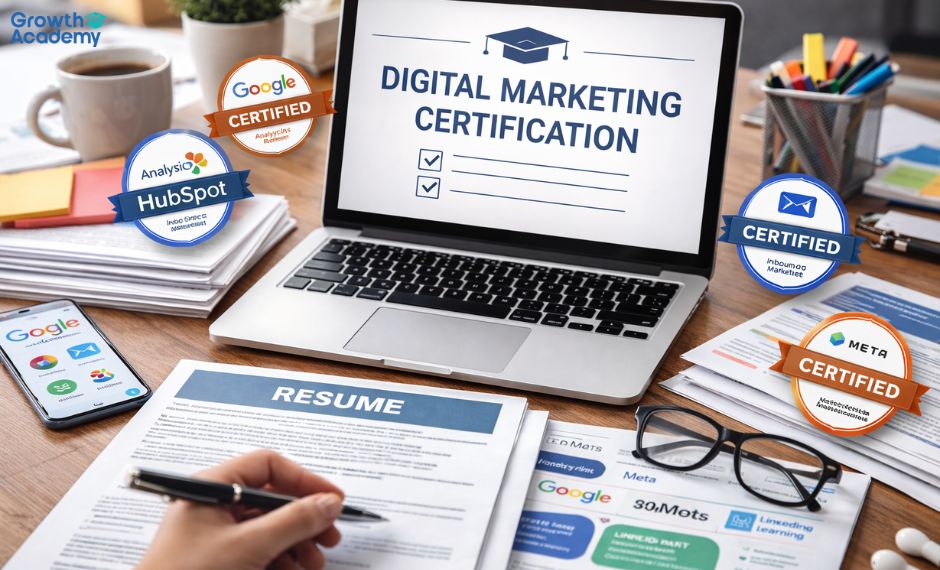
In 2026, anyone can watch a few YouTube videos and call themselves a "Digital Marketer." But when you walk into an interview, employers don’t care about how many videos you watch or how many blogs you read. They care about one thing: They want to know if you can actually handle the tools of the trade. Can you spend their budget without wasting it? Can you track the sales? Can you rank their website?
Certifications are the best way to bridge that gap between "I think I can do it" and "Here is proof I can do it." But with hundreds of options out there, which ones are actually worth your time?
Here are the 5 certifications that recruiters actually look for, and why they matter.
If you want to work in paid ads or performance marketing, this is the most important certification to have. Clients trust agencies with their hard-earned money to run ads on Search, Display, and YouTube. This certification proves you understand the mechanics of paid advertising and won’t burn through a budget with zero results.
Who is it for? Aspiring PPC Specialists and Paid Media Managers.
Difficulty Level: High. The questions can be tricky and scenario-based.
Time to Complete: 4 - 6 hours of study time.
Cost: Free.
Through this certification, you’ll learn how match types, Ad spend strategies, and negative keywords work in real-life scenarios. If you can explain to an interviewer how to lower Cost Per Click (CPC) using these strategies, you’re already ahead of 90% of candidates. Employers want to know you can save them money- not just spend it.
Marketing without data is just guessing. The GA4 certification is one of the most important on this list because it applies to everything. Whether you do SEO, Social Media, or Ads, you need to know how to read the results.
Who is it for? Everyone in marketing needs this.
Difficulty Level: Medium - High (depending on your experience)
Time to Complete: 10+ hours.
Cost: Free.
Why it helps: Employers love people who can look at a confusing chart and say, "This is why our sales dropped last week." It shows you have a logical, analytical mind. It proves you can track the "User Journey" meaning you know where customers come from and why they leave.
Posting a reel is easy; everyone can do that. But running a targeted ad campaign that brings in actual leads, That is hard. The Meta (Facebook/Instagram) certification tells employers that you understand the complex backend of the platform like Audience Manager, Pixel tracking, and A/B testing not just the creative frontend.
Who is it for? Paid Social Specialists, Performance Marketers, Social Media Managers who run ads
Difficulty Level: Medium to High.
Time to Complete: 1-2 weeks of preparation.
Cost: Paid (pricing varies by country and exam type)
Is it worth the money? Yes. Because it costs money and requires a proctored exam (where they watch you via webcam), employers respect it more. It’s much harder to fake than the free, open-book exams.
This is less about technical buttons and more about the mindset. It teaches you the Inbound methodology: how to attract customers naturally through helpful content rather than annoying them with spammy sales pitches.
Who is it for? Content Writers, SEOs, and Copywriters.
Difficulty Level: Low to Medium. It is very beginner-friendly.
Time to Complete: 3-5 hours.
Cost: Free.
Best for: People who want to understand the entire marketing funnel. It helps you understand how a blog post leads to an email sign-up, which leads to a sale. It gives you the vocabulary to talk like a professional strategist.
Online certificates are great, but they have a major flaw: they are theoretical. You can pass them without ever touching a real project. You can answer a multiple-choice question about SEO without ever actually fixing a broken link on a real website.
This is where a practical certification from an institute makes the difference. If you join the best digital marketing institute in Kozhikode, you shouldn’t just get certificates, you should get real project experience. That’s where Growth Academy stands out. You don’t just “learn digital marketing” - you actually do it through live campaigns and practical work.
Why this wins interviews: When an interviewer asks, "Have you ever handled a crisis?" or "Have you ever ranked a keyword?", a Google certificate can't answer that. But a certificate from a training program that includes an internship or live project experience can. That combination theory plus practical, real-world practice is what builds a career.
Having the right certifications is important, but showcasing them correctly is what catches a recruiter's eye. Many people make the mistake of burying their certifications at the very bottom of their CV where no one looks.
Here’s how you can highlight them effectively:
On Your Resume (The CV):
Create a “Certifications & Licenses” section right after “Skills” and list them like this:
Name of Certification – Issuing Authority (Year)
Example:
Google Ads Search Certification – Google (2025)
Advanced Digital Marketing Certification – Growth Academy (2025)
Add your badge link as a clickable hyperlink in the PDF so it’s easy to verify.
On LinkedIn: Don't just post a photo of the certificate as a regular post; it will get lost in the feed in 2 days. Go to your profile -> Add Section -> Recommended -> Licenses & certifications. Fill in the details and the "Credential URL." This permanently adds the logo of Google, Meta, or HubSpot to your profile, which looks incredibly professional.
The "Featured" Section : Use this space to showcase the practical assignments you completed during your digital marketing training in Kozhikode. Pinning a real strategy presentation or campaign report next to your certification shows proof of work and that matters more than a logo.
Certifications are a great start for getting shortlisted, but they don’t replace real practice. Use them to show you know the tools, and use your portfolio to show you can apply them properly. Start with Google fundamentals, add practical training, and you’ll have a strong profile for interviews.

Growth Academy
Room No: 206, 2nd Floor,
Calicut Business Center, Kallai
Kozhikode, Kerala, India - 673003
© 2025 Growth Education Hub LLP. All Rights Reserved | Privacy and Cookie Policy