
Simply ask a question to ChatGPT about some events that occurred in the past week, and there's a pretty good possibility that the AI will either not have the correct answer or that it won't even know how to respond to the query. If you ask the very same query using Perplexity, you can get a valid response accompanied by relevant sources most of the time. The mechanism being used in the latter case is RAG, and the approach might become one of the most important concepts in the AI domain.
If you are a person who needs to stay up-to-date with AI advancements for career reasons, business purposes, or just personal interests, we, Growth academy, being an experienced and the best digital marketing institute in Kozhikode, make sure we provide the best and the latest trends through our courses to make your step into the digital space easier.
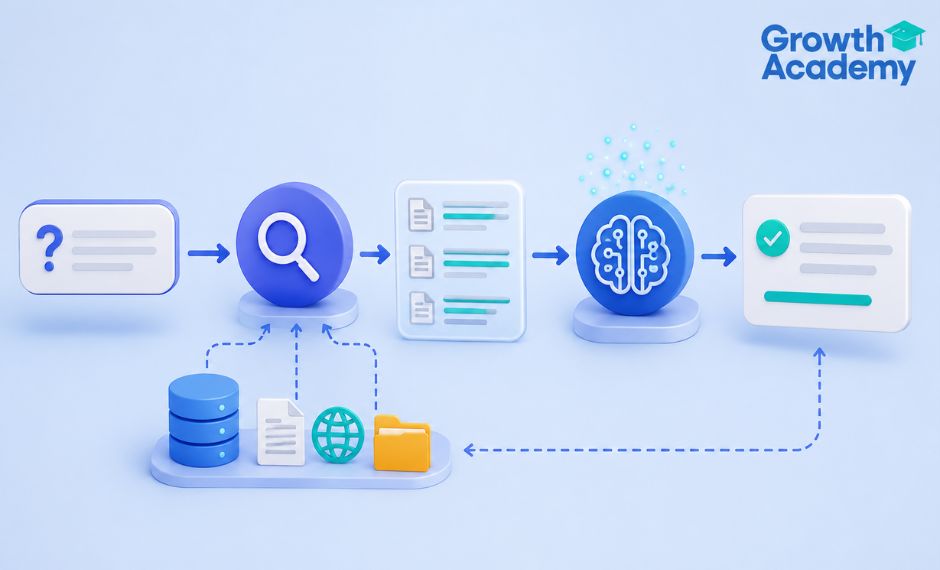
The Retrieval-Augmented Generation framework involves the use of two models: the retrieval model and the language generation model. The former uses the information retrieved to produce an answer, the latter makes use of all that it learned during the training phase. First, it retrieves the information related to the question asked, and then it generates an answer using that information.
It can be compared to an open-book and a closed-book exam. The former, which does not have the RAG approach, will simply answer based on what one remembers. The latter will open the book, locate the required page, and then come up with an answer based on what he has found.
Large language models such as GPT or Claude learn from an enormous number of text data up until a specific time. When learning is complete, the knowledge of the model becomes static. It doesn't know anything about the most recent launch of your product, today's news, or the PDF stored recently in your company's office server. Whenever you ask questions about any of these, it either takes a good guess or sometimes gives wrong answers. This phenomenon is known as "hallucination" in AI.
It wouldn't be cost-effective and time-consuming to retrain these large models whenever some information comes in. Instead, scientists thought of an alternative approach. Rather than providing all the information to the model beforehand, why don't we make it search for what it doesn't know? This is the whole concept of RAG.
Here is a step-by-step version of the process described simply:
Step 1: You pose a question.
For instance, you ask an AI assistant, “What is the current course schedule of Growth Academy?”
Step 2: The AI system does a search for the information.
It is no longer the case when the AI draws the answer from its pre-trained dataset. In the retrieval step, it looks for pieces of relevant information in a connected knowledge base (which can be anything from the company’s documentation, their website, or the Internet).
Step 3: The relevant pieces of information are retrieved.
In contrast to previous approaches where a whole document was fed to the language model, now only the most relevant pieces of information (a paragraph mentioning the dates of the courses) are fed to the language model.
Step 4: The model comes up with the answer based on the retrieved information.
Thus, the AI provides its response which now is based on the current information, not the memorized one.
As a result, the answer is more accurate, relevant, and much less likely to be incorrect or outdated.
RAG technology is already revolutionizing information searching and consumption process, which has an effect on marketing.
AI Overviews, ChatGPT with browsing abilities, Perplexity and many other AI-based tools use the RAG method to create their responses to users. Thus, when a potential customer poses a question related to your company's products/services, the response he or she will get can include the information retrieved from your website and used by the AI tool as its source. That's why such methods as AEO (Answer Engine Optimization) and GEO (Generative Engine Optimization) are gaining popularity in addition to classic SEO. If your website content is well-structured and answers user's questions, there's a chance that the AI tool will take the information from your website. Otherwise, it won't be considered at all. To sum up, the RAG technology shifts the focus from "rank on page one" to "get chosen as the source".
Let's consider the example of a customer support bot in a company selling industrial machinery parts. If the same query is posed to such a bot and RAG is not used, then the bot will provide the customer with out-of-date or generic information because it was trained on an older dataset.
The introduction of RAG allows the bot to look into the live inventory database, find the up-to-date information about the current inventory, and produce a relevant response. This is how RAG works in real business environments, and this is why RAG is widely adopted today.
In the case of Regular models, it makes the response based only on the information it gained during the learning process. However, the latter searches for information from a living source first and then gives a response. In essence, one depends on memory, while the other depends on research.
With developments in AI, the digital marketing industry doesn’t have to deal only with keywords and backlinks. The technologies and tools that are based on them have become part of the regular consumer activity. Knowing how these retrieval systems work and use the information will help marketers be successful and effective. Digital marketing course in Kozhikode at Growth Academy covers all possible shifts in the industry, starting with basic SEO and ending with new tools such as RAG.
Understanding the technologies used in RAG doesn't require you to be a developer. Instead, what is needed is understanding how information is used in the modern world, where everything works with AI technologies.
The concept of RAG may appear complicated at first glance, but the underlying principle is incredibly straightforward, that is, do not just depend upon memory; allow the AI to search first and then provide the answer. This single principle is responsible for making modern AI-powered applications seem smarter, up-to-date, and more trustworthy than those from just a couple of years back.
With the advancement of AI search technologies, the need to understand such terms has become mandatory for marketers. Looking to capitalize on these developments and forge a career in this field? Join the best digital marketing institute in Kozhikode – Growth Academy.

Growth Academy
Room No: 206, 2nd Floor,
Calicut Business Center, Kallai
Kozhikode, Kerala, India - 673003
© 2025 Growth Education Hub LLP. All Rights Reserved | Privacy and Cookie Policy