
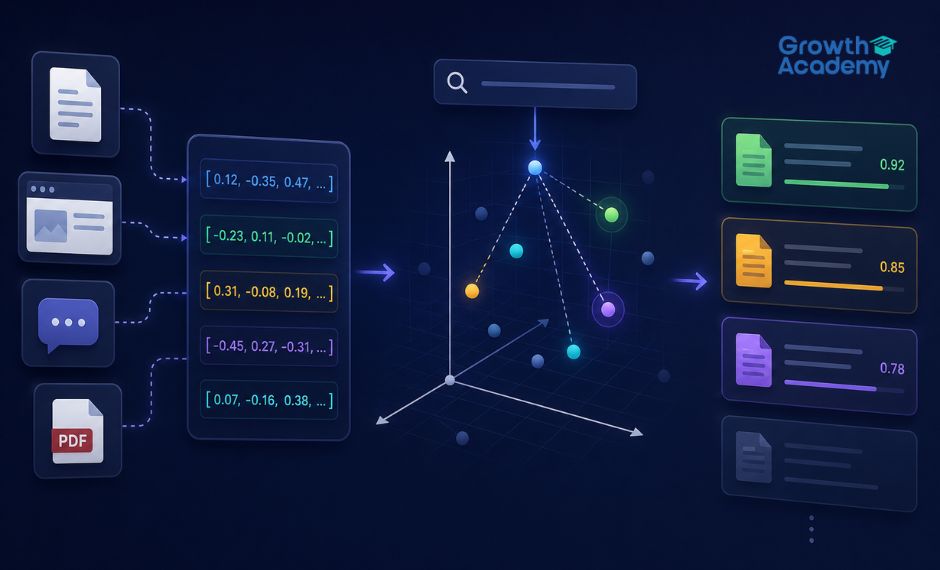
Type “Traditional café near me” on Google, and somehow it gives you an image of an elegantly lit coffee shop even though the word "Traditional" might not appear anywhere on that webpage. Isn’t it strange? In the past couple of years, such a search could have only been powered by simple text matching, but today, something else powers it. The name for this technology is vector search and this is something that marketers should pay attention to.
Vector search is a method by which search engines look for meaningful matches rather than keyword matches. While traditional search engines search for exact keyword phrases, vector search engines search for the embedded data, mostly numerical codes for utmost precision, thereby making the search results more effective. How does it do so? Well, each piece of content, whether it is a sentence or a product description or even an image, is translated into a series of numbers known as a "vector". You can imagine a vector to be a kind of coordinates system which locates the meaning of that piece of content. It is similar to the concept of GPS where it locates you in a real-life location, except that the vectors locate the meaning in the "meaning space" and contents with similar meanings get located next to each other.
For example, when you type "digital marketing training in Kozhikode", instead of searching for that particular keyword phrase, the search engine finds out content which is located in the proximity of the meaning, like "digital marketing institute in Calicut", "digital marketing institute in Kerala".
To be honest, vector search is not something completely new; tech giants have been using this technique for many years when building their image recognition algorithms and recommendation systems. But nowadays, vector search becomes more popular since it lies at the core of the AI-powered technologies that people have come to depend on in everyday life: whether someone asks ChatGPT a question or receives AI-powered Overview in Google search results, vector search is most likely running in the background and trying to understand the intent of the user.
For content creators, such changes represent a fundamental paradigm shift. For many years, SEO was all about including the right keywords into the website; however, it does not work this way anymore. Search engines and AI-powered platforms have gotten much smarter when it comes to interpreting the meaning behind certain words and phrases.
The temptation to believe that this is only applicable if you operate a very large platform cannot be blamed because vector search is suited for the behaviour of smaller everyday applications that businesses make use of without even being aware. For instance, product recommendation tools found on ecommerce websites, “related articles” portions found on blogs, and even customer service chatbots that comprehend rephrased questions all depend on the same concept.
And even if you have a local business or website, it is relevant to you. In case people are searching for "repair shops for laptop screens," and on your website you have used the phrase "services for repairing laptops," a search engine with vector-based understanding can still find the connection. This is good news for you because your content does not necessarily have to consider all possible ways customers will use to look for it.
To sum up, there is nothing technically complicated that you have to do. All you have to do is write naturally, as if you are writing for an actual person.
A typical search engine operates similarly to scanning the pages of a book index. This means that a search engine looks for the presence of your exact words and ranks pages accordingly. A page without your keywords will hardly be displayed despite being the most relevant to your search.
Vector search is different in the sense that it ignores exact matches and understands the context of a query. This allows a search for "how to lower screen time for children" to generate an article entitled "how to help children use fewer electronic devices," even when none of your words match the title or its contents.
Let’s say you’re going to the library to ask the librarian, "Hey, I need some reading material on a rainy day, but don’t give me anything that is very hard." Keyword search will provide you with everything that includes "rainy day" in its title. However, a good librarian, who understands your needs perfectly, can recommend you some fun book to read or a cozy detective story. Vector search acts just like that smart librarian, not like an ordinary filing clerk.
The change alters the manner in which content should be written. It will no longer work by loading one page with that keyword used up to 12 times. The new strategy involves writing naturally, elaborating on the topic at hand and utilizing related keywords and phrases in a conversational tone.
At Growth Academy, we have seen this trend influencing how brands should handle SEO in their current practice. Content has to address actual questions and be written in a manner that allows for easy readability by readers as well as AI systems. This is one of the reasons why we continue to update our digital marketing course in Calicut to accommodate the development of search technology, also we provide online digital marketing courses in Malayalam with the latest updated curriculum for our students.
It is important to understand that vector search is revolutionizing the way in which content discovery is done online through the process of shifting from keywords to meanings. It should be seen as an opportunity rather than a threat by business owners and marketers, since valuable content becomes even more important now.
Are you interested in how changes influence SEO practices? Learn more about this by enrolling into the digital marketing course offered by Growth Academy.

Growth Academy
Room No: 206, 2nd Floor,
Calicut Business Center, Kallai
Kozhikode, Kerala, India - 673003
© 2025 Growth Education Hub LLP. All Rights Reserved | Privacy and Cookie Policy